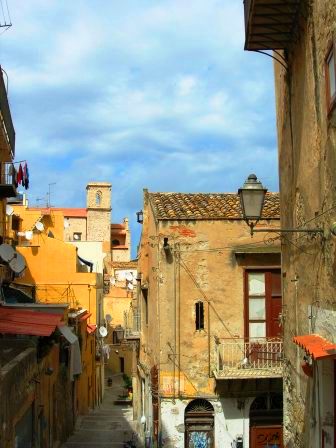
The town of Termini
Imerese, whose
population numbers about
26,000, is located on
Sicily's North Coast in
the province of Palermo,
roughly mid-way between
Cefalù and the Sicilian
capital Palermo.
Termini, as it is
usually referred to, is
about 38 kilometers east
of Palermo or about 25
minutes by train or car.
The town is divided into
two parts: Termini Bassa
(Lower Termini) and
Termini Alta (Upper
Termini). Almost all of
the town's historical
attractions are located
in Termini Alta, since
that area effectively
comprises the town's old
historic center. Lower
Termini is where the
railway-bus station and
the hotels are located.
Termini is wedged in
between the sea and the
steeply-rising slopes of
Monte San Calogero, the
peak that marks the
beginning of the Madonie
Mountain Range which
runs east towards
Messina and South to the
vicinity of Enna. Viewed
from the sea, Termini
presents a
picture-postcard image
of a Sicilian seaside
town. The view from
Termini looking out over
the sea to Palermo is
likewise spectacular.
Termini is famous for
its elaborate Carnival
(Mardi Gras) festival,
which is ranked along
with Acireale's and
Sciacca's Carnevales as
one of the best in
Sicily.
The name
Termini Imerese
is derived from
the Latin "Thermae
Himerenses" or
"Hot Springs of
Himera." Indeed,
the remains of
arched Roman
aqueducts are
visible at
Termini. The
name also
derives from the
toponymic "Imera"
which was the
name the ancient
Greeks applied
to the
settlement near
present-day
Termini that
they came to
occupy. The
story of
Imera
is the only
historically
noteworthy
episode that can
be linked to the
ancient history
of Termini
Imerese.
Imera
was founded in
678 BC by Greek
colonists from
Zancle (Sickle),
modern Messina.
Zancle itself
had been founded
in the previous
century by Greek
colonists. It is
probable that a
prehistoric
settlement
already existed
there, populated
by Sicanians.
The Greek town
of Imera
represented the
furthest
westward
penetration of
the Greeks on
the North Coast
of Sicily, and
thus,
represented a
threat to the
Carthaginians,
who had
colonized the
western area of
Sicily and
founded
Palermo
and
Solunto,
the latter city
being only 30
kilometers
distant from
Imera. In 480
BC, the
Carthaginians
decided to
invade the
region. Hamilcar,
a Carthaginian
general who was
an ancestor of
the famous
Hannibal who
later fought the
Romans,
assembled an
army said to
number 30,000
men to march
upon Imera. The
Greeks of Imera
sought and
received help
from their
fellow Greeks of
Agrigento and
Syracuse. The
three combined
Greek armies
literally
massacred the
Carthaginians,
and thus the
Carthaginian
threat to the
Sicilian Greeks
was effectively
eliminated, at
least for the
remainder of
that century.
In 409 BC,
Hannibal,
grandson of
Hamilcar, led a
large
Carthaginian
army against
Imera. This
time, the Greeks
were defeated
and Imera was
destroyed. It is
believed that
the survivors of
the battle fled
to either
Termini or
Caccamo
(famous for its
Norman castle),
and founded the
two towns or
developed
existing
settlements.
Most of
Termini's sights
are located
within walking
distance of one
another. At
Piazza Duomo, we
have, of course,
the Duomo, or
Mother Church,
dedicated to San
Nicola di Bari
(St. Nicholas of
Bari), "Santa
Claus." Built in
the late 1400's,
it houses a
painted cross by
Pietro Ruzzolone
dating from
1484. However,
the church was
extensively
renovated during
the 1600's and
that accounts
for the many
Baroque Period
works of art it
contains.
Proceeding
towards the sea,
one comes to
Principe di
Piemonte (Prince
of Piedmont)
Belvedere, which
offers panoramic
views of the
sea. At the end
of the
Belvedere, the
winding road
which is called
"Circonvallazione
Castello" leads
you downhill to
the Villa
Palmieri, a
public park and
garden with
plenty of shade
trees. Completed
in 1845, the
Villa contains
the remnants of
an old Roman
structure, which
was either the
town forum or
the basilica of
an early
Christian
church; scholars
are in
disagreement
over which of
the two it was.
Leaving the
Villa and
doubling back
towards Piazza
Duomo along Via
Barrinelli, one
arrives at the
church of Santa
Caterina (St.
Catherine). The
church was
erected in the
1400's and has
frescoes dating
from that era
painted by the
brothers Nicolò
and Giacomo
Graffeo.
The Civic Museum
is on Via del
Museo. The
Museum has an
extensive and
interesting
exhibition for a
relatively small
city like
Termini. It is
is open daily
from 9:00 to
1:00, when
visitors can
view its
collection of
ancient
archeological
objects from the
nearby area, and
a good
numismatic
collection.
Several of the
lions' heads
from Imera's
Temple of
Victory are
located here;
others are
housed in the
archeological
museum in
Palermo. There
is also a large
stone slab with
Arabic
inscriptions
written upon it,
believed to have
been suspended
over the city
gates of Termini
during the
period of
Saracen
domination.